Showing posts with label India. Show all posts

Our Second Visit to Simhatulam Temple


On our second visit to Simhatulam Temple, R, who was initially supposed to come with us on the study abroad but ended up not being able to, came with us during her visit to Vizag. While we were at the temple, she and C decided they wanted to shave their heads (like E did on our first visit).


Just a couple of baldies!


Wedding Take Two


The second wedding we went to was the niece of our other translator Rajah Lakhmi. This was a Brahman wedding, which is considered to be the highest caste in India. This was also an arranged marriage, but because the bride was still in school they had a year long engagement so they had time to get to know each other. 


Rajah Lakshmi told us to come at 2 pm, so we did. However, it turned out the rest of the guests arrived at 7:30 so we had some time to kill.


Christian and I on the roof's structure


The bride and groom posed for pictures at every stage of the marriage ceremony

Mother of the bride, sister of the bride, bride, bride's grandmother (l to r)
The girls all joined the bride as she was getting ready; she will wear seven sarees throughout the night.

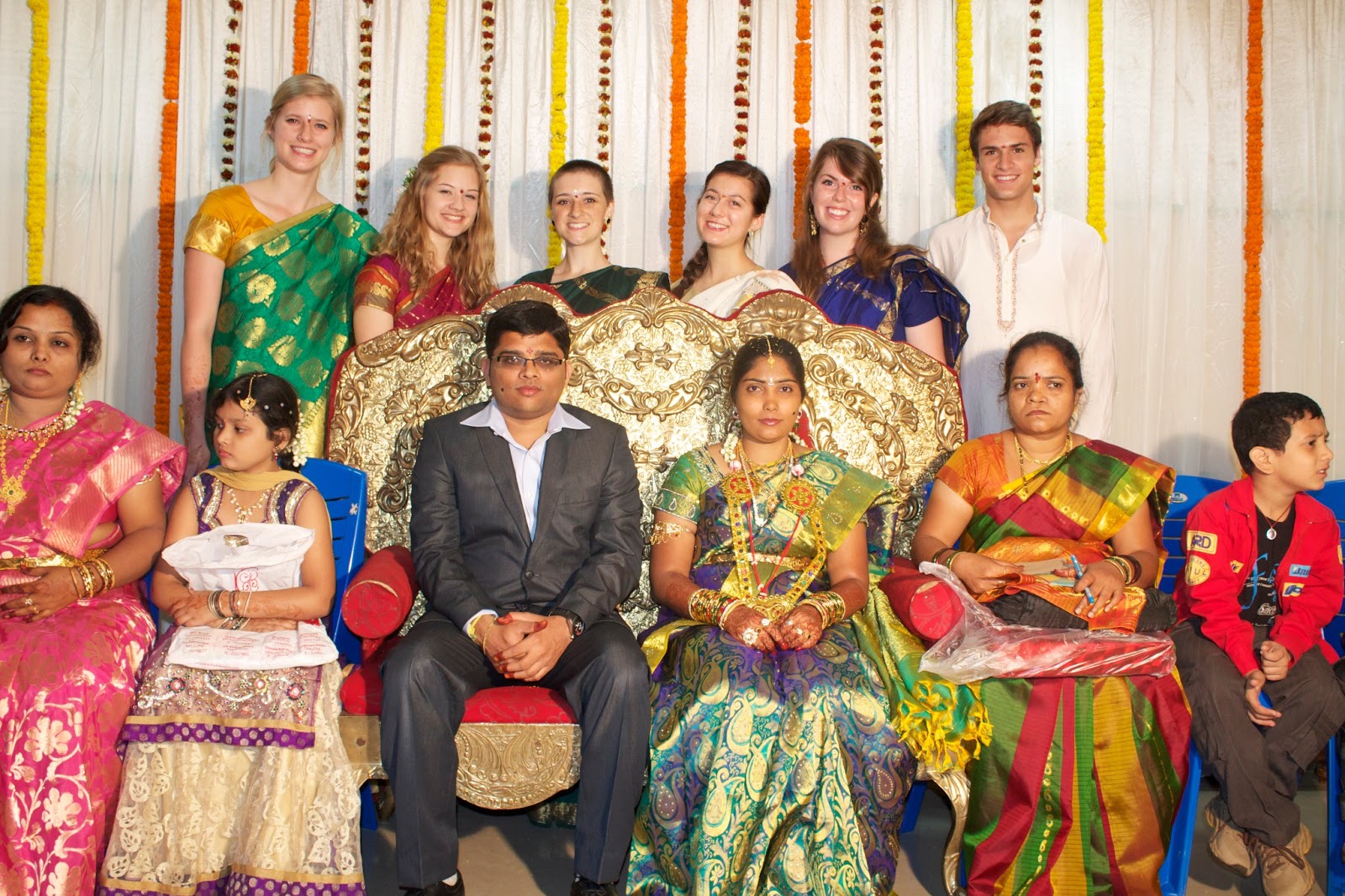
The wedding party

The bride carries a special coconut throughout the wedding ceremonies which was blessed and offered to a god


The bride sat in the flower-box for four hours; her father and brother carried her out to the stage for one of the marriage ceremonies. At this point a Brahman priest was blessing her prior to the ceremony.

At this portion of the Brahman marriage ceremony the bride and groom sit on opposite sides of a white sheet; they cannot see each other and perform rituals including the bride washing the grooms hands under the sheet.


The groom with the Hindu symbol for prosperity on the white sheet


Here they are placing patties of jaggary, a mix of other spices, and tiger rice on each other's heads as the Brahman priest chanted

Now they are 90% married! At this point it was 2 in the morning, so the six of us headed home rather than stay for the final ceremony at 4 am

An Auspicious Week for Weddings

The first wedding of the week was for the cousin of our translator, Madhu. As are 90% of marriages in South India, Madhu's cousin's marriage was arranged. Madhu explained the process for an arranged marriage; first the man goes to a local priest and tells him that he wants to get married. Next the priest sorts through the women who have told him they want to get married and picks out a few who are a suitable match for the man (based on a balance of appearance, education, financial stability, and caste). The potential groom then goes through the girls chosen by the priest, chooses one of the girls, and he and his parents meet her and her parents. After the parents talk, if they decided their children were a suitable match, the groom-to-be asks how his potential future bride feels about getting married. If she is okay with it, the parents sort out a dowry and plan a wedding!


Wedding henna

Dressed in our wedding best

According to Hindu tradition, it is best to get married at the time the stars dictate is most auspicious (which is the only adjective I hear). In the case of this wedding, it happened to be at 3:59 am. The dinner was at 7 pm, so we all headed out at 6 to begin the wedding festivities!


The entire alleyway was strung with lights and they lit off firecrackers from their hands next to a crowd of people. One was accidentally knocked off its course and burst just above a little boy


The dance party ended up being a lets-watch-the-American-girls-dance party, so we quickly got uncomfortable and stopped

The bride and groom sat in those chairs for five hours under the hot lights without any food or drink
(Sorry about the poor quality)


Remember those DARE classes where they tell you to 'Just say no' to drugs? The same thing applies when a man hands you a child and asks if he can take a snap. Just say no. Otherwise, before you know it, you're surrounded by a crowd with camera phones.

At the end of it all, we were happily exhausted!

Picture Summary of January

Group of children who followed us around for a few hours

Beautiful Muggulu (the beautiful and colorful powder drawings) at a competition during a Pongal festival. Early every morning one of the girls at the house makes one on the dirt road in front of our house to welcome prosperity and welcome others into our home.


All of a sudden we were ushered onto a stage--we still aren't sure why


One of our translators, Madhu
Oh hello food poisoning
Indian subway


Chenari and her husband--it's blurry, but I love how happy they are as newlyweds!

Every Step You Take, They'll Be Watching You

There are some very distinct social differences between the U.S. and India; one of these is the social acceptance of staring. In India, not only is it completely socially acceptable but it's the norm to blatantly stare at anyone walking by. Well, as long as that anyone is white.

Everywhere we go we are a major object of attention and everyone stares; we are the only white people I've seen in Visakhapatnam so far and we stand out quite a bit. However; the types of staring can vary.

1) The Gape-and-Recover
This type of staring is usually reserved for use by children or mothers with children. It starts with a startled gaping from afar, but once they recover from their shock they they will approach us and talk to us. They ask us what our names are and laugh at our inability to pronounce theirs.

2) The Drive-by
When scooters drive us as we are walking, they can tell when coming from any direction that we are white. As the scooter passes us, everyone riding turns his or her head to keep us in their line of sight. This usually makes us worried for the lives of the passengers because no one on the scooter is watching where the scooter is headed.

3) The Rickshaw Duck
We mainly travel around Visakhapatnam on rickshaws, which has a low-hanging roof which blocks the view of our faces from the average passerby. In order to see our faces, people on the road come as close as they can to the rickshaw while traveling on their scooter, rickshaw, bike, or car and duck their heads as low as they can in order to see our faces in the rickshaw.

4) The Leer
My least favorite of the stares; it's quite unsettling and causes me to locate and move towards the nearest guy who's on the program with me. It involves a group of men standing together just watching us as we walk down the street; occasionally there is an attempt of contact. This usually just means the boldest of the group comes over and asks for a 'snap' or a kiss, at which point C, the lone male in our group, shoos the leerers away.

5) The Pass-by
This is my second least favorite type of staring; beaten only by the leering stare. It's similar to the drive by but is specific to buses. It happens often; buses pass by and everyone on the bus presses themselves to the window and watch us pass; this means there are usually upwards of 50 pairs of eyes silently watching from the bus window as it passes. Even worse is when the bus is stopped and as we walk past the bus every eye is on us as we slowly pass the long bus.

While all this staring can be unsettling, a majority of the time it comes from a pure curiosity at the oddity that is white BYU students wandering around.

Life as an Honorary Man

Since I've been in India I've been the recipient of many benefits: one of which is the title of an honorary man. Indian society is divided into castes and within those castes men are ranked higher than women. At meals the men, served by the women, eat first. After the men are done, the women, children, and household help eat. However, because I'm considered to be more highly ranked than the household help, while in India I'm considered to be an honorary man and am allowed to eat meals with my professor and the on site director as well as receive other benefits only men can have.

My professor has been forming connections in India for the past 40 years and he has a very close relationship with the king in Visakhapatnam. The king found out we were planning on visiting Simhachlam temple, a nearby Hindu temple dedicated to the god Vishnu, and he called the temple informing them that we are guests of the king and that we are to be allowed into the inner sanctums of the temple; a portion of the temple which usually only people who pay 20,000 rupees are allowed in.

These women do everything at our home from cooking and cleaning to helping us get dressed in traditional Indian attire and doing our hair.
Sidhu, the 11 month-old boy who lives with us, with temple statues made 15,000 years ago (or so our translator said--he may have been exaggerating or could have meant 1,500)
Once we got into the inner sanctum, we were able to participate in several traditional Hindu rituals.
One of these rituals, the Puja, was one where, in the middle of the inner sanctum, you put your hands on a silver plate with holy basil leaves on it and the priests recite a prayer for you. After everyone has a chance, he came back around with a bowl of flavored water and poured some in my hands and I drank it and poured the leftovers onto my head. We then rotated clockwise around the shrine and received a portion of holy basil (we was sternly told not to let it touch the ground as it would be not auspicious) as the priest put a silver crown-like-headpiece onto our heads for a second and chanted a blessing to keep the demons away. (Or for fertility. It seems like every blessing is for fertility.)

When we left the room with the shrine, came to a room with a pillar decorated with flakes of gold and paint powder. One by one we (the females of the group) hugged the pillar then turned around with our backs to it and we were tied to the pillar with a sash while the priest chanted a blessing. This ritual was to bless us with fertility and "many many children". (See? Fertility.)

We were led to a small room with about six musicians, including some holy Indian clarinet players. These players played a song and then a priest chanted over us, tossing rice onto us. We were told later that the man who was leading us around the temple, the king's doctor, had never seen that ritual performed before and that it is usually reserved for the kings and presidents of India; we were very fortunate to be recipients of such an honor.

On our way to leave the temple we stopped at an alter where we each took a small bowl filled with animal fat and lit the wick on an already lit bowl and place it on the alter. When it was my turn, I did so, turned around to leave, and a man standing by the alter stopped me and bent down. He then started to worship my feet; stroking them and bringing his hands to his face as Hindus would do in the presence of something sacred. My professor had never seen this happen before and told me that this form of worship is reserved for people who are of much higher caste and power. My professor told me that most likely the man believed I was the reincarnation of a important and powerful person.

Before we went into the inner sanctum of the temple, we went through a portion of the temple where people who had bargained with a god and whose prayer has been answered are able to shave off their hair as an offering to the god. One of the girls in my group, E, decided that she wanted to have the full experience of India and shaved her head! She's now bald and has no regrets. (Plus she's much cooler in the India heat and humidity)

Portion of the temple where barbers are available to shave heads; we watched this small child have her head shaved

New Country, New Rules


India in one word: hectic. It is so incredibly hectic here! Everything is hectic, even the tastes, sounds, and smells. India has a very...particular kind of smell. I think it comes from the smells of dirt, urine and garbage mixed in with spices and plants. It's very unique to India; I've never smelled anything like it before. The same goes for the food, I've never tasted anything like it before, but in a good way. The food here is amazing, we have four cooks who make us three meals of authentic Indian food a day, but it is spicy. Despite loving almost everything relating to Indian culture, I cannot handle spice. So far, everything here has tasted the same to me--spicy. I'm sure I'll get used to it, it's just bombarding right now. The most hectic sense of them all is the sounds here in India. Before I came here, I thought driving in Boston was loud. India blows Boston out of the water: every action a driver takes he honks his horn. Driving here is a very different experience; it has it's own particular set of driving laws (as found on previous traveler's blog:

Article I: The assumption of immortality is required of all road users at all times.
Article II: Indian traffic tends to work on something resembling the olde caste system. The following precedence must be accorded at all times.  In descending order, give way to:  cows (do not mess with these ever), elephants, heavy trucks, buses, official cars, camels, light trucks, buffalo, jeeps, ox-carts, private cars, motorcycles, scooters, auto-rickshaws (you), pigs, pedal-rickshaws, goats, bicycles (goods carrying), handcarts, bicycles (passenger carrying), dogs, pedestrians, gap year students.
Article III: All wheeled vehicles shall be driven in accordance with the maxim: “To slow is to falter, to brake is to fail, to stop is defeat.”  This is the Indian driver’s mantra.
Article IV: Use of Horn:
(IV, A-C): Cars:
  • Short Blasts (urgent): Indicate supremacy, ie. in clearing dogs, rickshaws and pedestrians from path, and meaning “Im late home for my tea - the wife won’t be happy”.
  • Long Blasts (desperate): Denote supplication, i.e.  oncoming truck “I am going too fast to stop, so unless you slow down we shall both die”
  • Single Blasts (casual): “I have seen someone out of India’s 1.2 billion whom I recognise”; “There is a bird in the road ahead”, “My word, I had an epiphany” or simply and most commonly “I have not blown my horn for several minutes”. 
(IV, 2A): Trucks and buses:
  • All horn signals have the same meaning, viz, “I have an all up weight of approximately 12 tons and have no intention of stopping, even if I could”.  This signal may be emphasised by the use of headlamps (full beam is usually preferred here). Be aware that many truck drivers rest bricks on the accelerator and take up a cross-legged seating position. They will not touch the brake, ever.
(Article IV is subject at all times to the provisions of Order of Precedence in Article II above.)
Article V: All manoeuvres, use of horn and evasive action shall be left until the last possible moment. If the manoeuvre is left until too late then the horn should be used again.
Article VI: In the absence of seat-belts (which there is), passengers shall wear garlands of marigolds. These should be fastened at all times. In the absence of marigolds passengers shall close their eyes.
Article VII: Right of way: Traffic entering a road from the left has priority. So does traffic from the right, and also traffic in the middle.
(VII.I):
  • Lane discipline: All Indian traffic at all times, and irrespective of the direction of travel, shall occupy the left, the right and the centre of the road. If the road is full to capacity, the occupation of the hard-shoulder is more than acceptable.
Article VIII: Roundabouts:  These are fondly known as circles in India. Circles in the middle of crossroads have no traffic management function.  Any other impression should be ignored. If in doubt use your horn and close your eyes.
Article IX: Overtaking:  is mandatory. Every moving vehicle is required to try to overtake every other moving vehicle, irrespective of whether it has just overtaken you.  Overtaking should only be attempted in suitable locations, such as in the face of oncoming traffic, on blind bends, at junctions and in the middle of villages / city centres.  No more than 2 inches should be allowed between your vehicle and the one you are passing – one inch in the case of bicycles or pedestrians. When overtaking is not possible then undertaking is just as good (sometimes better)
Article X: Nirvana may be obtained through the head-on crash, alternatively, you may find it whilst squatting at the side of the road, emptying your bowels of that ‘bad idea curry’ you had the previous night.
Article XI: Reversing is no longer applicable, since no vehicle in India uses their reverse gear.
Article XII: The 10th incarnation of God was an articulated tanker.
Article XIII: The state of the road is non-negotiable. If there is a road you should think yourselves lucky.

I've only been in India for two days and I laughed when I found it because it is so incredibly true and there is no better way to describe it.

Because I'm the only student here so far, the most effective way to get around has been on the back of my professor's moped. It's strange and scary riding on the back of a moped navigating around traffic in India. Once the rest of the students arrive, we'll be mostly taking rickshaws around. But never fear, rickshaws themselves are quite the experience, so I won't be lacking in frightening adventures.

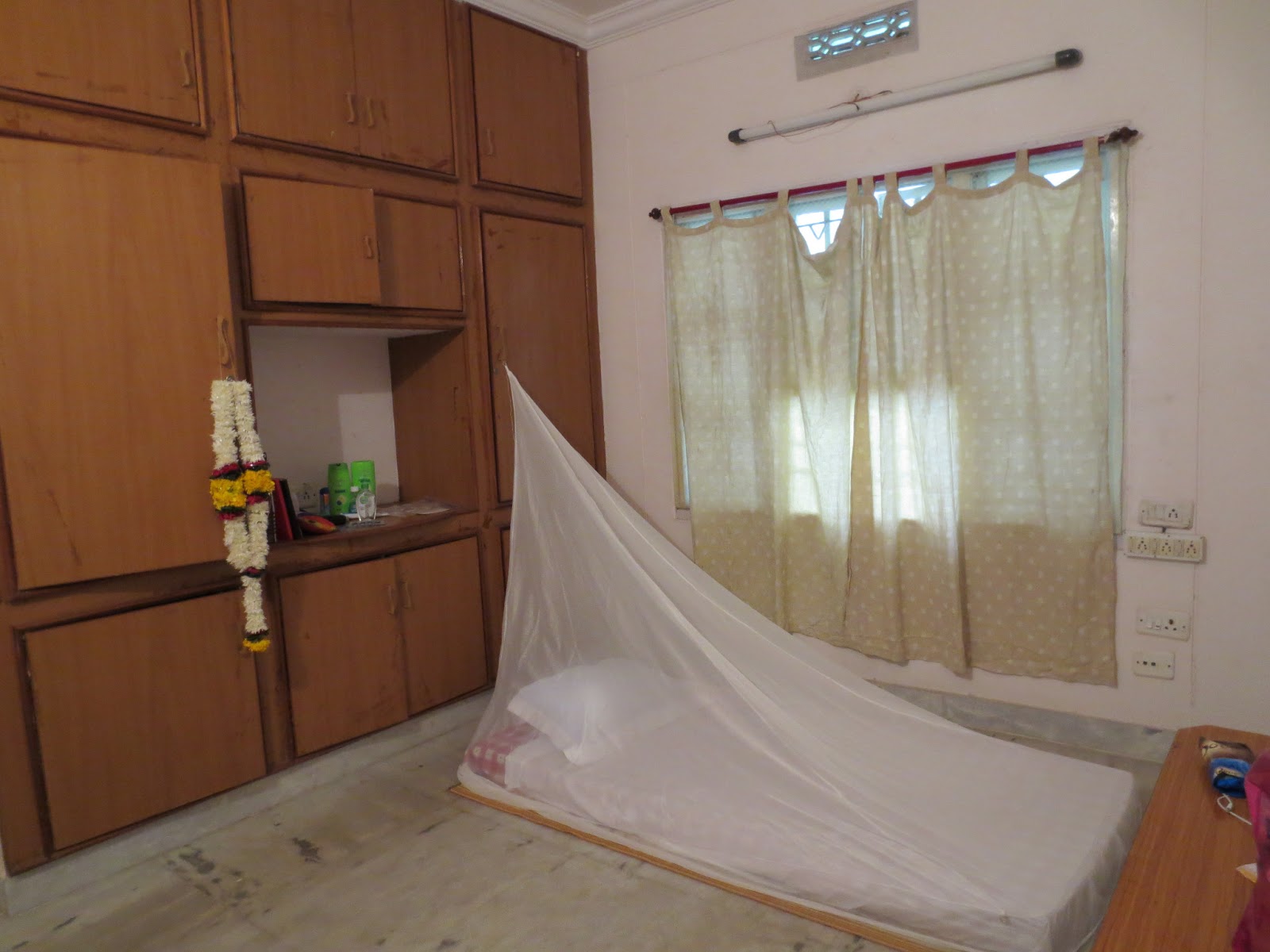
My bed with a mosquito net
The view of the neighborhood from my balcony